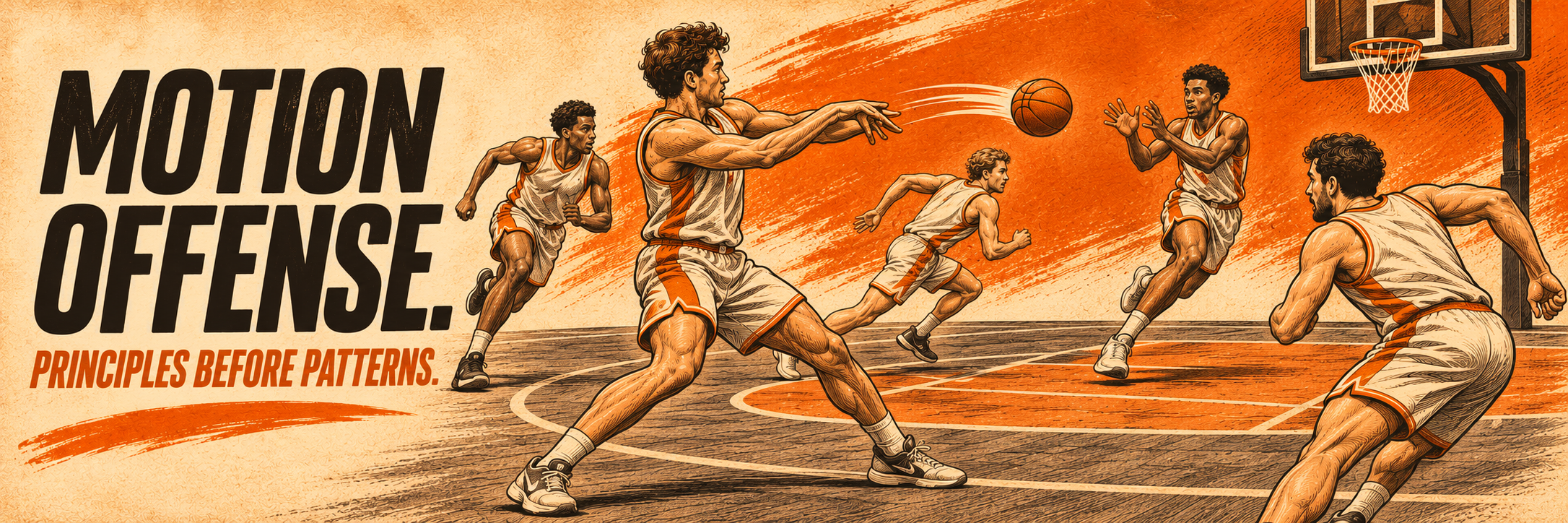
Five players. Shared decisions.
Motion offense gives players room to use their skills, their judgment, and their creativity. The coaching challenge is getting five decisions to work together.
A player attacks an opening. A teammate sees that attack and clears the lane. Another opens a passing angle. The possession develops through connected choices. That connection is what we have to teach.
Driving is one useful tool in this offense. So are passing, cutting, screening, and playing through the post. Build a team that can recognize which tool fits the possession.
Separate the tools from the principles
The tools are actions players can execute: give and go, movement on the weak side, a ball screen, a screen away, a pass into the post, or a drive that draws help.
The principles organize those actions. They tell players how to share space, when to move, and what makes the next choice useful. A team can own plenty of tools and still get in its own way if the principles are unclear.
Choose a manageable set of tools for your group. Teach each one, then show how it connects to the others. Adding another action only helps when players can recognize a reason to use it.
Movement needs a purpose
I use three seconds as a teaching reference for stagnation. A player should not settle in one place while the possession dies. The ball should not sit while everyone waits. This is an offensive teaching principle, separate from any rulebook count.
Movement has to improve the picture. Open a lane, offer a target, occupy a defender, or make room for the next action. Running into a teammate’s space gives the defense an extra helper.
When a teammate has a driving opportunity, avoid cutting directly across the front of the ball. Read the action and choose a route that keeps the advantage available.
Make the defense change its shape
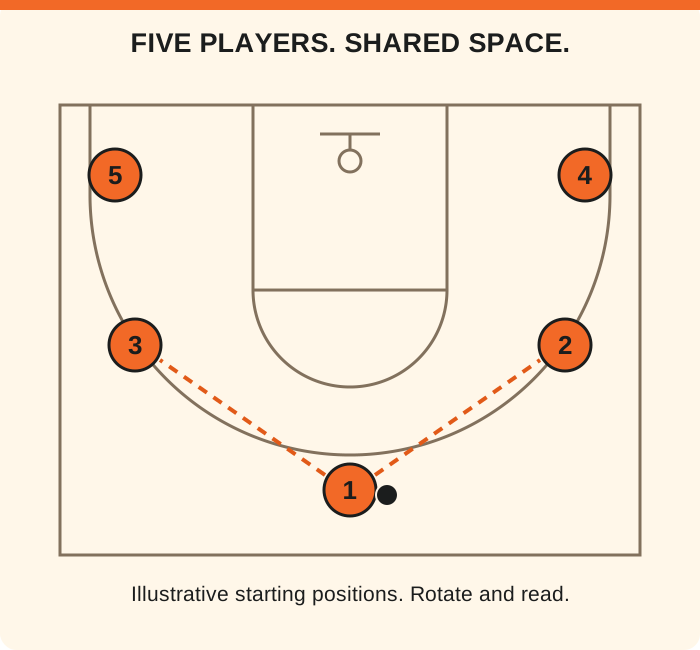
Move the ball from side to side and connect the perimeter to the interior. A drive, a post entry, or a pass deep to the corner can change the defense’s angles. The next pass should take advantage of that change.
Pay attention to the passing line. Two teammates can be close enough for a pass and still offer a poor angle. Adjust the position so the ball handler can see the target and deliver the ball without forcing it through a defender.
Start with Stop Yelling “Space Out.” Teach Space. when players need help recognizing how their position affects the whole group.
Let a screen away open more than one option
A screen away creates possibilities for the receiver, the screener, and the player with the ball. The receiver may come free. The screener may find an opening toward the basket. The ball handler may gain room to drive while defenders attend to the screen.
Teach players to see those possibilities together. A screen is useful because of the advantage it creates. The offense still has to recognize and use that advantage.
Watch the location. Bringing another screen and another player into an already crowded ball side can close the passing angles you wanted to open. Ask whether the action creates space for a teammate.
Teach with Freeze and Go
Let the possession develop. When a useful teaching moment appears, freeze the action with everyone still in position. Identify the problem together: a blocked lane, two players arriving in one space, or a passing angle that disappeared.
Move back one action. Restore the starting picture and ask the player what else was available. Then call Go and let the players experience the adjustment immediately.
Keep the correction specific. The purpose of the stop is to help players read the next possession. Repeated long explanations make it harder to retain the picture they just saw.
Give players experience in different positions
Begin with an open structure that allows players to move through different areas of the floor. A player who handles, passes, cuts, finishes, and receives in several positions gains more ways to contribute.
A predetermined route can move everyone through every spot. Motion offense adds responsibility for choosing the route. Players learn to respond to the ball, the defense, and one another.
As the group develops, a high post can become a connecting point against a zone. Keep the same attention to angles, movement, and shared space.
Give the learning time to connect
The early possessions may look messy. Players hesitate, choose the same space, or move before a teammate can use an opening. Use those moments to teach the shared principles.
Introduce the action families separately when the group needs clarity. Then connect them gradually. Watch for better decisions, useful spacing, and teammates responding to one another. A rehearsed sequence alone cannot tell you whether players understand.
Continue with Build Motion Offense Step by Step, then use Small Games, Big Decisions to test those principles in play.