A useful tool needs a useful read
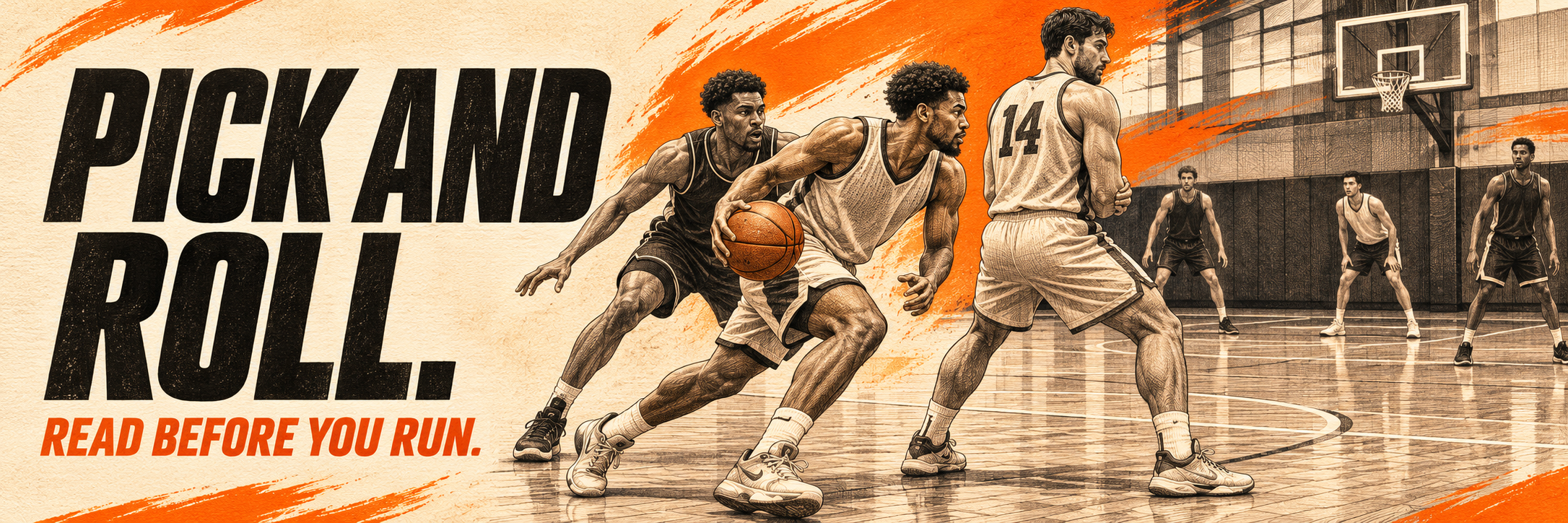
I use the pick and roll as part of my motion offense. The important work is teaching players to recognize what happens before the screen, during it, and after the defense responds.
A ball screen can create an advantage. Repeating the action without reading the result can also waste a possession. Players need passing, cutting, screening away, and penetration alongside it. The ball screen belongs inside that larger toolbox.
Start with Motion Offense: Principles Before Patterns for the shared framework. Then give this tool the detailed teaching it deserves.
Teach the angle and the timing
The screener’s position changes the route available to the ball handler and the route the defender must take. Coach the approach, the body position, and the angle with the actual defenders in view.
Teach the screener to establish a legal, stationary position before contact. The ball handler has to give that screen time to develop. Leaving too early lets the defender escape the problem before the offense creates it.
Then teach when to release the screen. Staying without a purpose can clog the next action. Leaving without reading the defender can remove the advantage. The players have to connect their timing.
Identify the defensive response
Give the players a clear picture of the coverages they actually face. Does the defender go under? Do the defenders switch? Does the screener’s defender step out and recover? Do two defenders stay with the ball? Is the defense trying to keep the ball on one side?
Choose one coverage to teach first. Let players recognize it at a manageable pace, then let the defense execute it live. A name helps the group communicate. Recognition tells the player what to do next.
Look beyond the two defenders nearest the ball. The next helper may decide whether the useful play is a drive, a pass to the screener, or a pass away from the screen.
Connect the solution to the situation
The screener can roll, open to space, or become a short passing target. The ball handler may attack, use a retreat dribble to regain space, or work with the screener to change the angle and screen again.
These are possibilities to teach and test. A roll is useful when its timing and passing line fit the coverage. Opening away from the basket matters when the player can receive and threaten from that space. A retreat dribble should help the player see and organize the next action.
Do not turn every possible answer into an instruction for the same possession. Begin with the response the defense presents most often, teach the details, and build the next layer when the players can recognize it.
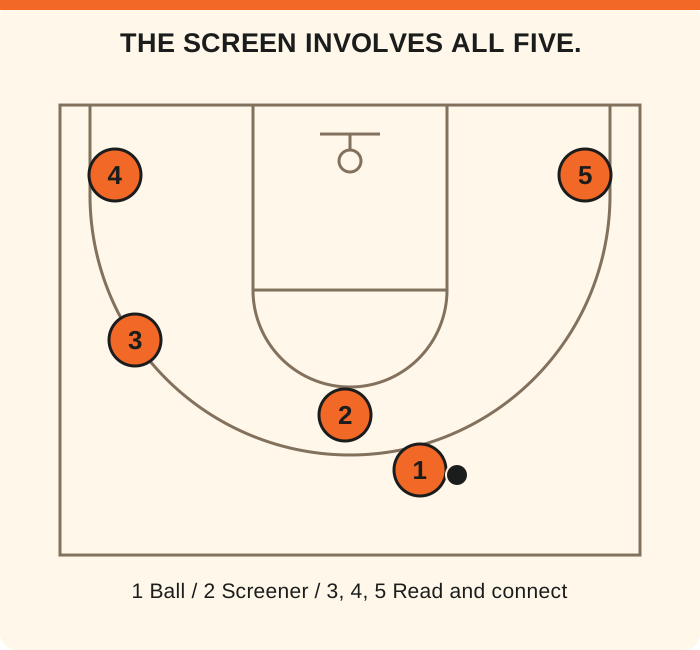
The other three players are part of the action
Three teammates away from the screen influence the space available to everyone. Their defenders may help on the roll, close the lane, or leave a receiver available.
Teach those players where they can be seen and how to preserve a passing angle. If a helper commits, the teammate that defender leaves must be ready to receive. If a drive opens, a careless cut across the lane can erase it.
In practice, follow the possession beyond the first pass. Can the receiver recognize the next defender? Can the team continue the advantage without stopping to restart the offense?
Change the pairing
Try different players as the screener and the ball handler. Explore different locations on the floor. The familiar pairing may be useful, but the team should understand the action well enough to recognize another opportunity.
Match the task to the players’ skills. A new pairing can expose a mismatch, improve a passing angle, or reveal something the usual arrangement hides. Keep the purpose clear so the change helps the possession.
Teach the counter to the counter
Once the offense finds a solution, the defense adjusts. Bring that adjustment into practice. A player who only rehearses the first answer may stop seeing the possession as soon as the picture changes.
Use Freeze and Go. Stop a revealing moment, identify what the defense changed, move back one action, and let the players try again. Keep the question specific: what became available, and who could see it?
Aim for an effective action with purposeful dribbles and clear timing. Extra steps and extra bounces often give the defense time to recover.
Demand teaching from yourself
If we expect players to read a coverage, we have to give them opportunities to learn that read. Teach the mechanics, show the defensive picture, and test the decision with teammates and opponents involved.
Use Small Games, Big Decisions to isolate a shared principle. Then return to five players so the ball screen reconnects with the whole offense.