The first requirement of every defense
What is the most basic element of defense? I open my defensive clinics with that question. Coaches talk about stance, pressure, communication, effort. Those all matter. But my answer comes before any of them: get there.
A defense that arrives late cannot use its system. Before adding another press or another coverage, teach the team how to get back, on time, with clear responsibilities. I have seen that work help teams compete with stronger opponents.
Keep the principles. Adjust the matchup.
I separate strategic transition defense from tactical transition defense. Strategy gives us the responsibilities that stay in place. Tactics adjust those responsibilities to a particular opponent, such as exceptional speed or an immediate threat from three.
Do not confuse an unfavorable individual matchup with a broken defense. I want a defender in front of an attacker and the floor balanced. We practice handling temporary mismatches. When necessary, we solve them while the possession develops.
First defender: the rim
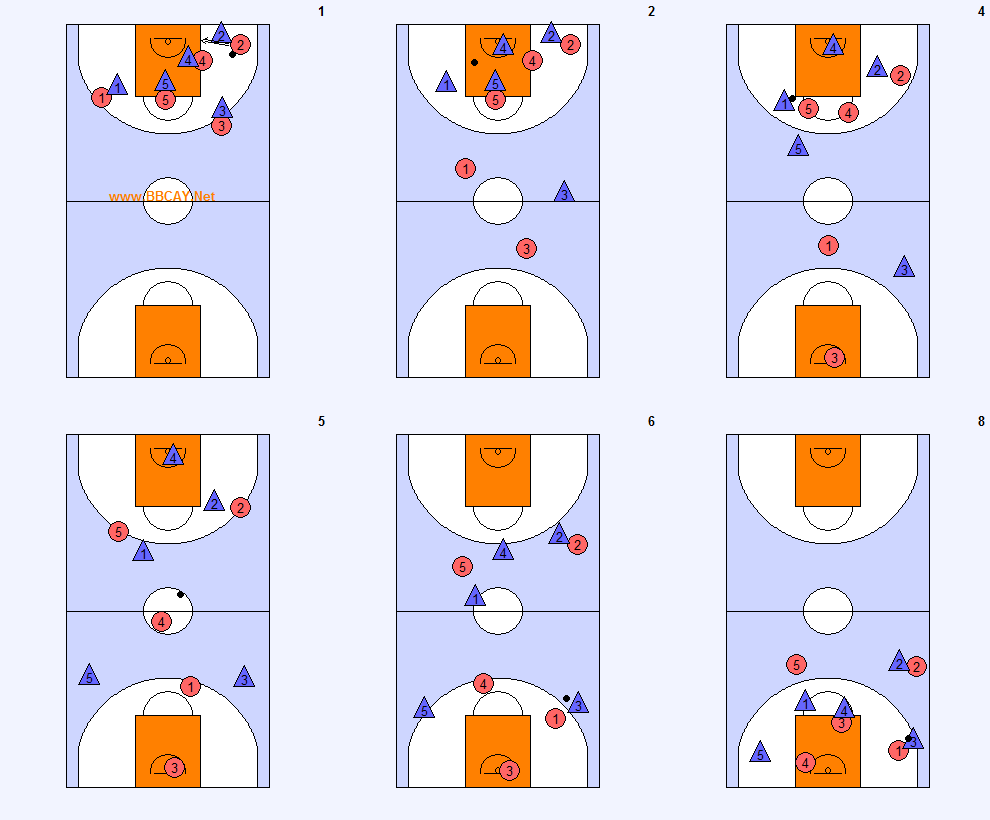
Our offensive rebounding commitment and our defensive recovery must work together. In the original example, player O2 shoots. O3 recognizes that he is the first player back. His job is immediate: sprint to the small arc beneath our basket and call “Rim.”
He stays responsible for that space until help arrives. He runs toward the basket facing the direction of his sprint, rather than backpedaling the full distance. Get to the position quickly, then establish vision and legal defensive position.
That first responsibility protects against the easiest finish. If the first defender goes hunting for the ball too early, the weak side can become an open runway to the rim.
Second defender: the ball
O1 sees that he is the second player back. He calls “Ball” and takes responsibility for containing the ball. He does not stop to find his original assignment.
The first two defenders have different jobs. The first protects the basket. The second gets to the ball in time to interrupt the attack. The communication tells everyone else which responsibility is already covered.
Third defender: the weak side
O4 is third back. He moves to the weak side to protect the pass inside. That positioning can close the easiest passing window and sometimes create a steal that starts our own break.
The final two players, often those involved in offensive rebounding, pick up the closest available attackers. We accept a temporary mismatch before we accept an unguarded player. Communicate and repair the assignments when the situation allows.
Make the offense do one more thing
My objective in transition defense is to prevent easy, quick baskets and influence the pace through our defense.
My broader defensive goal is to make the offense complete one more action than it intended: another pass, another dribble, another decision. That extra action takes the opponent away from its preferred rhythm.
Rim. Ball. Weak side. Nearest available player. Those words have to become decisions the players can make while sprinting.
Take it into practice
Coaching application: start a live possession with a shot and continue immediately in the opposite direction. Vary the shooter and the rebounding outcome so the same players are not always first, second, and third back.
Check the responsibilities before judging the final result. Did the first player protect the rim? Did the second contain the ball? Did the third cover the weak side? Did the remaining players find an assignment?
Practice temporary mismatches and recovery communication. A rehearsed sprint with fixed positions does not test whether players can recognize their job in the changing game.
“Make each day your masterpiece.”